The challenge
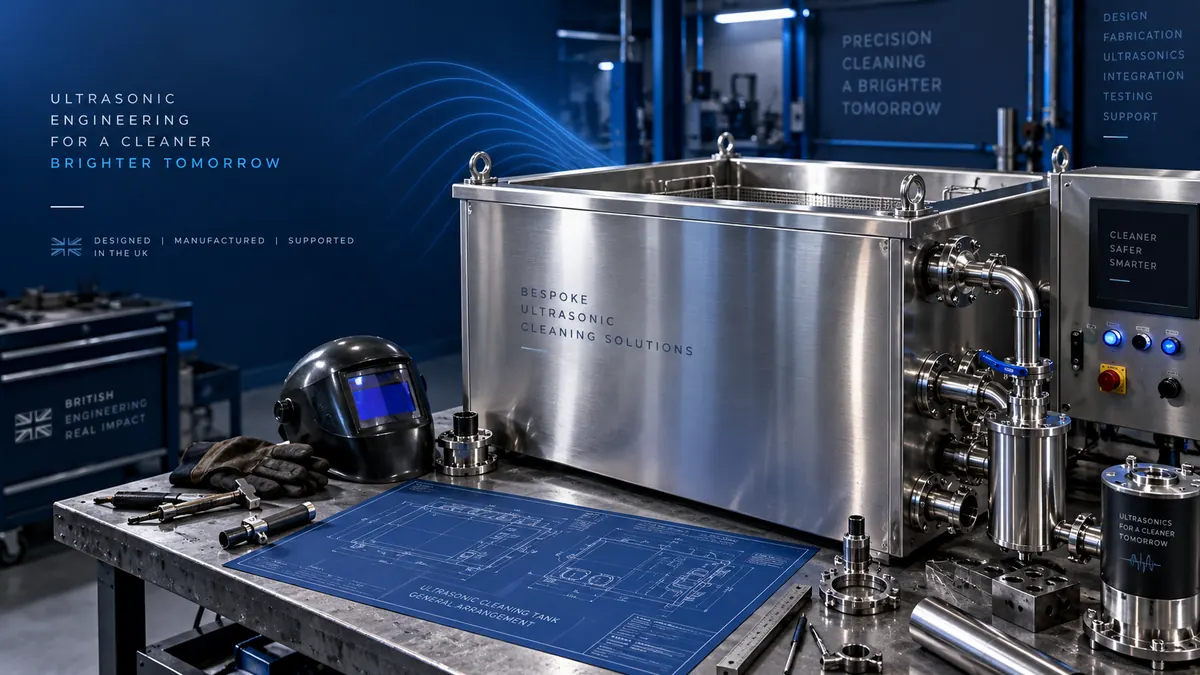
The components did not suit a standard off-the-shelf tank. The cleaning process had to account for awkward geometry, practical loading, the available footprint and the way the parts would move through production.
Rather than starting with a fixed machine size, the requirement was treated as an engineering problem: what needed to be cleaned, what contamination was present, how the parts could be handled and what the operator needed from the process.
The UTS approach
UTS worked from the application backwards, considering tank dimensions, ultrasonic coverage, heating, controls and the supporting process around the bath.
- Tank dimensions based on the real component envelope
- Ultrasonic power and transducer arrangement considered around the working volume
- Heating, filtration and circulation options reviewed for the process
- Basket, lid and handling requirements considered before fabrication
- Commissioning and long-term service access built into the project thinking
The result
The customer had a purpose-built route matched to the application instead of a compromise around a standard catalogue machine. The project also created a clear basis for future maintenance, upgrades and process support without inventing unnecessary complexity.
Why the bespoke route mattered
The value of a bespoke system is not simply having a different tank size. It is the ability to design the working envelope, loading method, ultrasonic coverage and support equipment as one process.
That gives operators a clearer, repeatable route and avoids adding workarounds later because an off-the-shelf machine was never designed around the part.